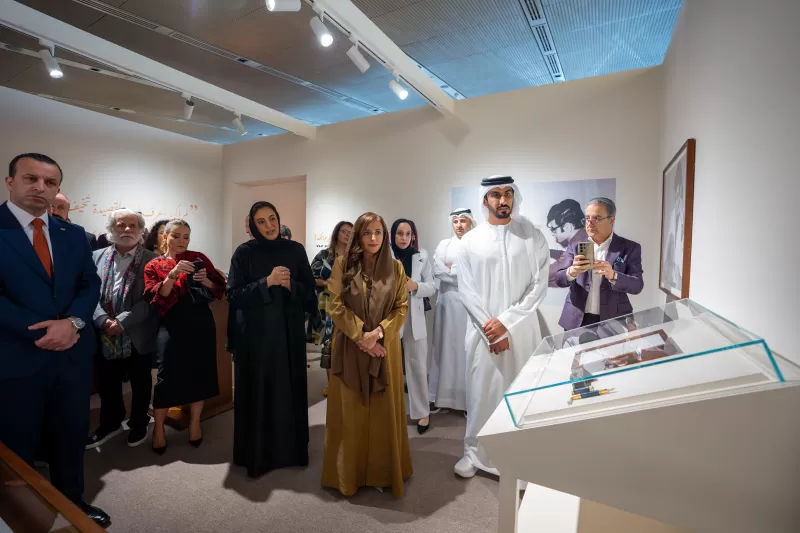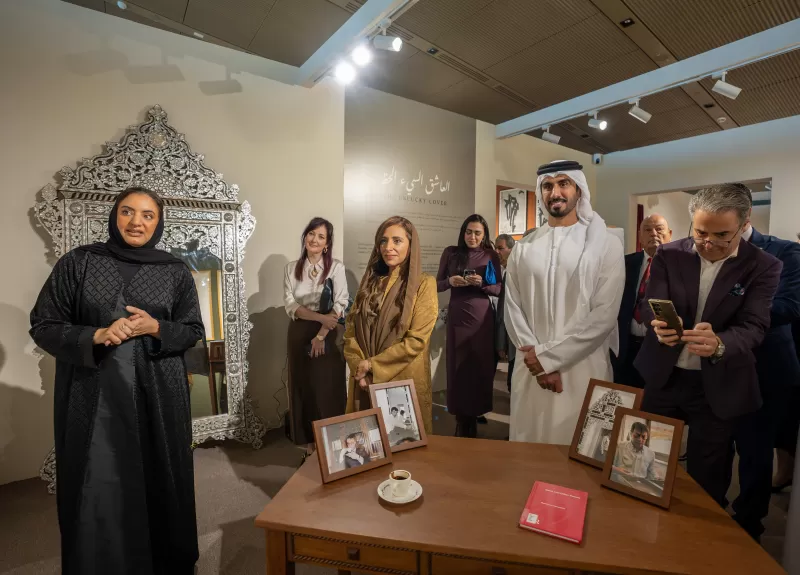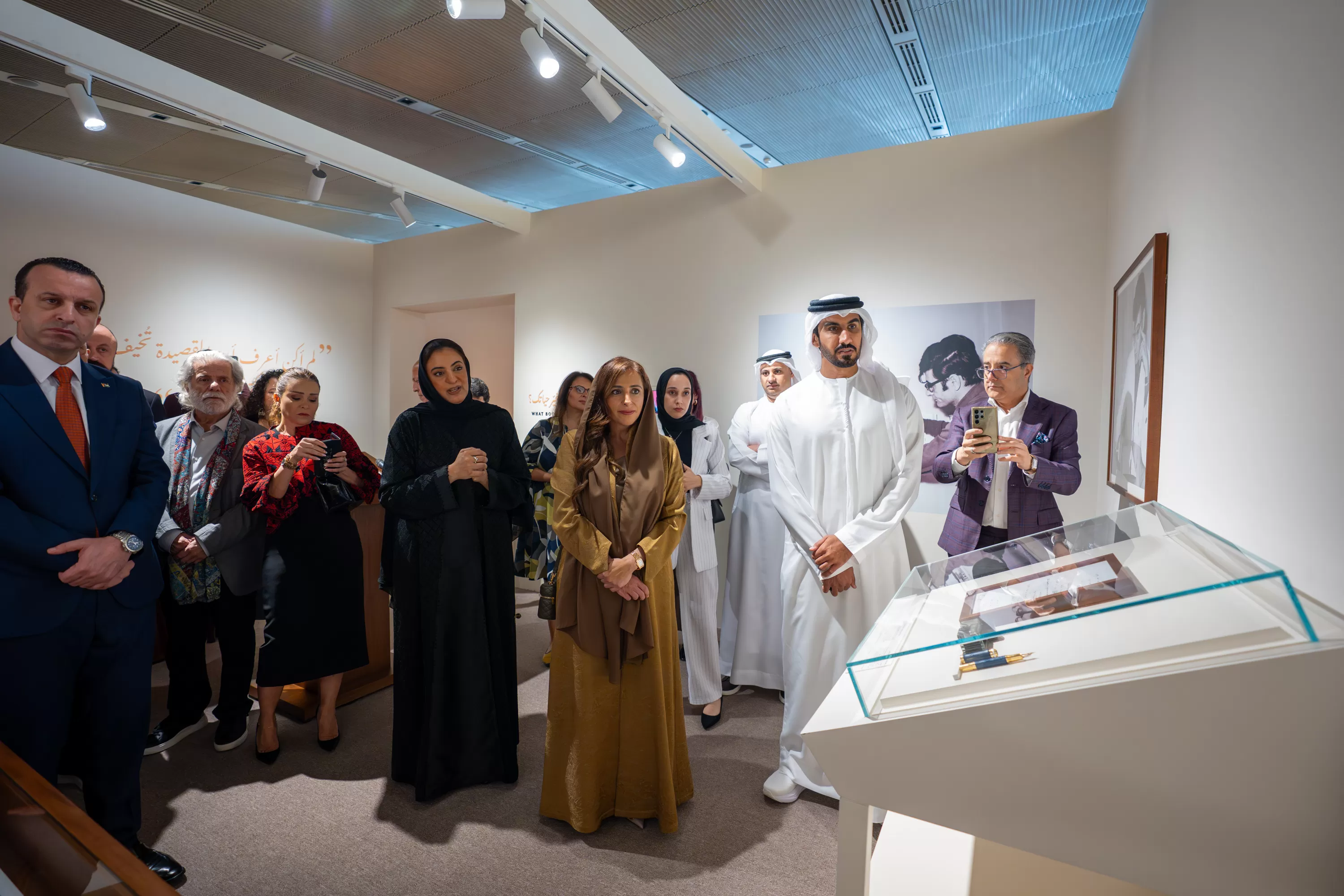
The House of Wisdom in Sharjah has inaugurated the exhibition “The Dice Player: Mahmoud Darwish”, in partnership with the Palestinian Museum, the Mahmoud Darwish Foundation, the Barjeel Art Foundation, and the Khalil Sakakini Cultural Centre, along with other cultural institutions. The exhibition offers visitors a visual and auditory journey that traces the life of the Palestinian poet from his early beginnings to his enduring presence in Arab and global memory. It runs until 13 March 2026.
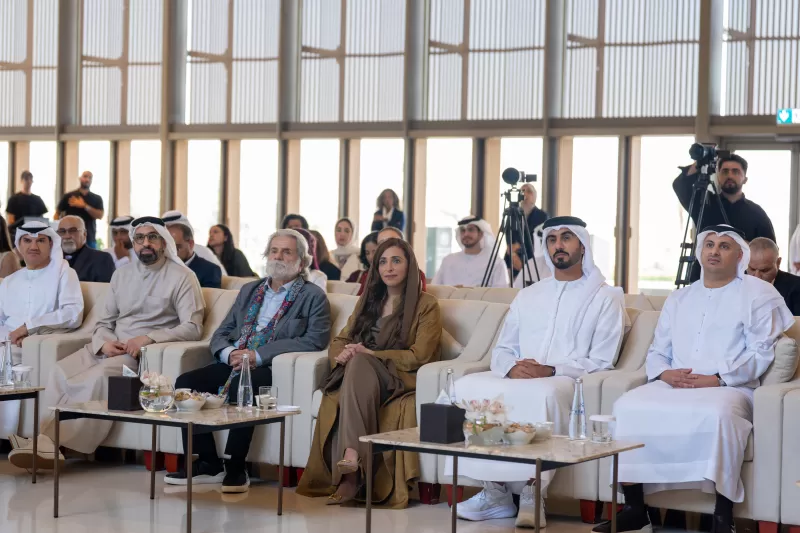
The opening ceremony was attended by cultural, artistic, and media figures, including representatives from the UAE Ministry of Culture and Youth, the Consulate General of the State of Palestine in Dubai, and official bodies from the Emirate of Sharjah, in addition to cultural partners. The musician and composer Marcel Khalife presented a musical performance featuring some of the most notable works that connected him with Mahmoud Darwish. He spoke briefly about his relationship with the poet and his experience composing the poem “The Pigeons Fly” after Darwish’s passing, which he performed at the memorial ceremony.
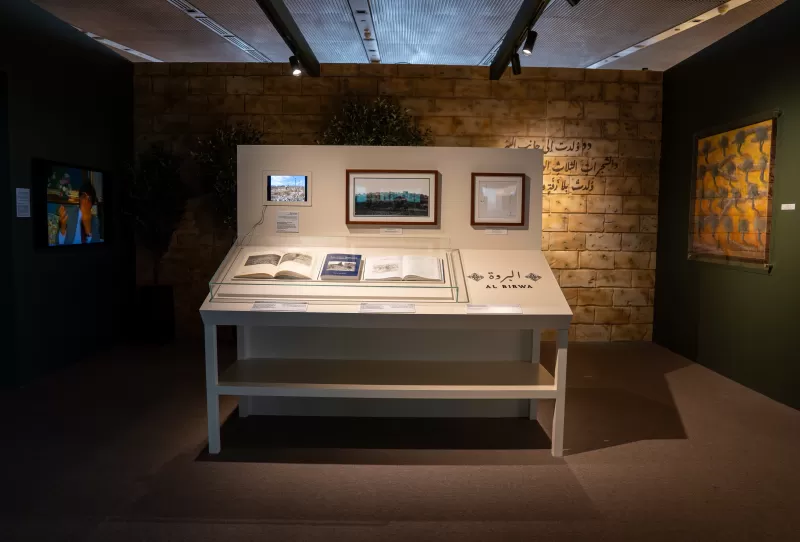
The exhibition’s concept is built around the image of a dice as a metaphor for the many facets of Mahmoud Darwish’s life and work. Visitors move through six interconnected sections that reveal the threads of his poetic and human journey. The path begins with his roots in the village of Al-Birwa in the district of Akka, where photographs, documents, and manuscripts highlight his childhood, his early bond with place and family, and the enduring presence of the village in his writing as a symbol of loss and memory.
The journey then moves to the section dedicated to the formation of his poetic voice, tracing his years of study in Haifa and the beginnings of his literary career, through rare editions of his earliest collections and archival materials that shed light on the development of his language and early readings. The third section explores the experience of exile in its many stages, from being a “refugee in his own homeland” under surveillance and arrest, to his movements between Moscow, Cairo, Beirut, Tunis, and Paris, and finally to Ramallah. Documents, investigations, letters, and travel records reveal the transformations that shaped his identity and his political and poetic vision.
The exhibition also reflects on the presence of love in Darwish’s life through documents, photographs, and manuscripts that reveal the emotional dimension of his writing, alongside artworks that explore the human depth of his poetry. Darwish’s role as a voice of cultural resistance is highlighted through key materials, including an identity card and scenes from the documentary “Record, I Am an Arab”, as well as items related to his relationships with prominent Palestinian cultural figures such as Edward Said and Naji Al-Ali. The exhibition includes a dedicated space for his poetry evening at the Sharjah Cultural Theatre in 1996, in addition to documents related to his visits to the UAE.
The final section focuses on the last years of the poet’s life, presenting audio recordings of “Jidariyya,” along with photographs from his funeral in Ramallah in 2008, and a rare text in which he imagined his own funeral. The experience concludes with artworks inspired by his presence and poetry, affirming that although he is absent, his voice remains alive in collective memory.
Amer Shomali, Director General of the Palestinian Museum, said: “In one evening I sat only two metres away from Mahmoud Darwish. It was an exceptional moment in which I felt I was seeing and hearing him for the first time. Today, this exhibition has brought back that feeling, placing us at the same distance from Darwish, a distance that allows for a genuine closeness to his living legacy. This has been made possible by the tremendous efforts of the participating institutions, foremost among them the House of Wisdom and Sheikha Bodour Al Qasimi, who offered the Arab public a rare opportunity to enter behind the scenes and engage directly with the poet’s experience”.
Shomali added: “I believe that the highest role of cultural institutions is to open their backstage to the public and make culture accessible and clear. This exhibition has succeeded in presenting Mahmoud Darwish’s poetry in a direct and transparent way that deepens this sense of closeness”.
The participation of the Palestinian Museum in this project is part of its ongoing efforts to support exhibitions and initiatives dedicated to presenting Palestinian cultural heritage through research-driven visual and archival approaches. The museum contributed documents, photographs, and artworks that help construct the core narrative of the exhibition.
A cultural programme accompanies the exhibition in Sharjah, featuring panel discussions, poetry readings, and documentary screenings with writers, critics, and artists who knew Darwish personally or worked on his literary legacy. The programme continues until 13 March 2026, coinciding with the poet’s birth anniversary.