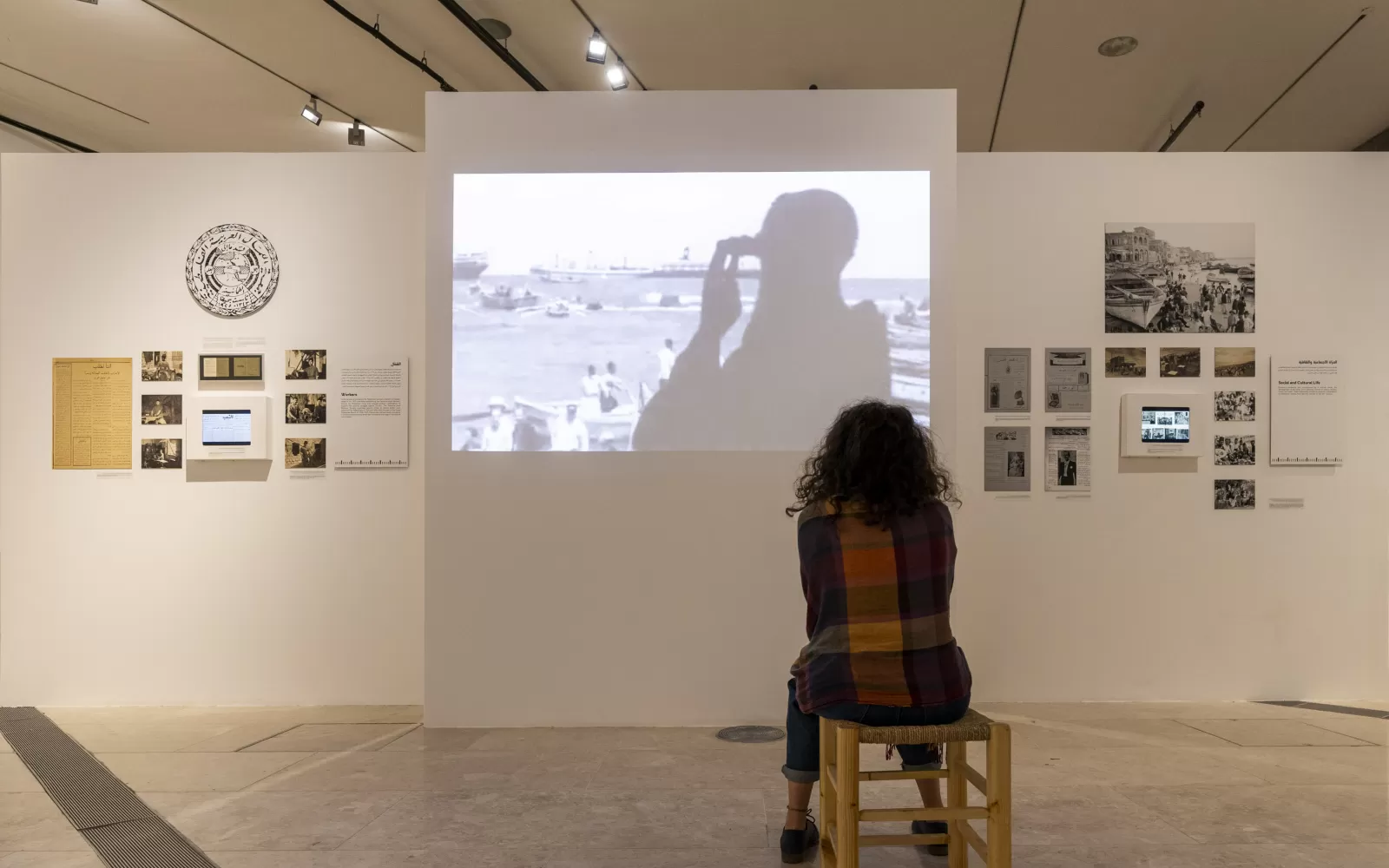
Gaza Remains the Story

Thank you for your interest in hosting our exhibition “Gaza Remains the Story” and helping in spreading information about Gaza and Palestine.

Here we’ll walk you through the simple process of choosing the components of the exhibition and their accompanying designs and visual material, and how to print them afterwards.

The team at the Palestinian Museum will support you every step of the way towards bringing the exhibition to life in the hosting space of your choice. The exhibition material is designed to fit your interest in the downloadable material according to type and available display space. The material includes 46 experience boards, 66 archival photos, 20 artworks, a comprehensive media package to promote the exhibition on your social media platforms, as well as 48 QR codes to links that provide more information and in-depth analysis. Provide your audience with an immersive visual, audio, and educational experience about Gaza and Palestine.

We also provide you a set of designs for memorabilia that you can print as merchandise or giveaways in support of Gaza and its story.
 

Exhibition guide

This guide explains how to download, print, and curate this exhibition in your space of choice. 

Step 1

Choose a space and its dimensions

Whether it is a gallery space, lobby, corridor, interactive hall, or a sidewalk, take dimensions of the usable walls, to be able to decide which format will fit in the allocated space. Take into consideration the audience flow, and the lighting source.

Step 2

Design the exhibition layout

Based on the available space, choose either the full curated version offered, or design your own layout using a combination of the materials offered. This guide offers detailed instructions on how to print and set up the "Gaza Remains The Story" exhibition. It includes information on poster dimensions, display options, and layout recommendations to help create an engaging and visually impactful exhibition that tells the story of Gaza's history and culture.


Step 3

Download

Download the full curated version or the combination of your choice from the list below. Available sizes 50*70cm or 29.7*42cm.

Step 4

Lets announce your exhibition

Social media kit
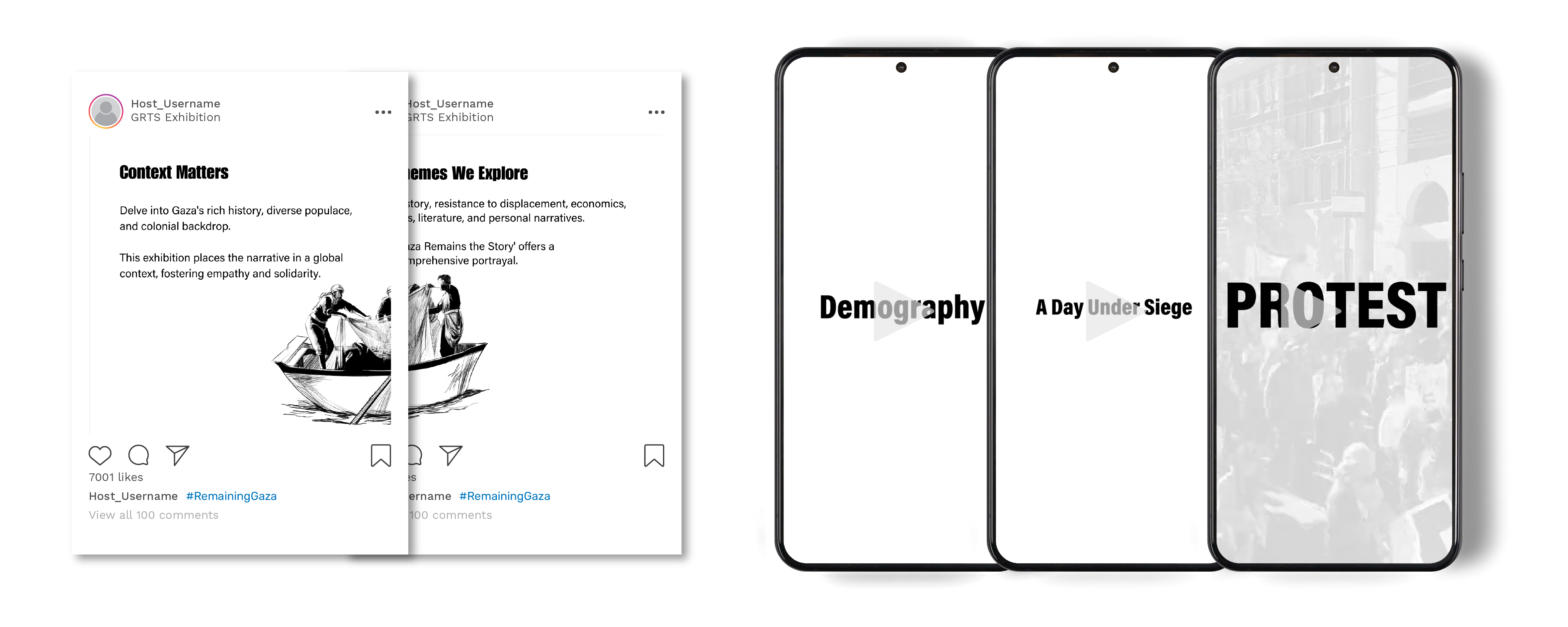
Media kit

How to use the social media kit: The Gaza Remains the Story exhibition is supported by a media package tailored to promote the exhibition across social media platforms, aiming to increase its impact. The exhibition consists of multiple topics, each of which contains two publications with images and a video reel, all of which were shared through the Palestinian Museum’s social media channels (Instagram, Facebook, TikTok, LinkedIn, and Twitter (X)). 

Each of these publications will highlight a different topic, according to the following proposed publishing schedule:

  • First post: A short promotional video about the exhibition.
  • Second post: Publications per the main exhibition topic, each of which contains a set of texts and images. They can be shared in the order you see fit. For example, you may choose to share it on four consecutive days, or at four different times in two days.
  • Subsequent posts are about other topics within the exhibition, each of which contains a reel video and two posts, which you may choose to share on three consecutive days, or at three different times in one day.

Notes:

  • We encourage our partners to adopt this programme to increase views and synchronise post-sharing across different platforms to achieve continued interest in the exhibition and gain public support. Publication times are otherwise at your discretion.

  •  Videos and posts are titled with the same name as the theme they were created for.

  • You can display posts on your social media platforms during peak times for that platform.

  • We invite you to use unified hashtags on all your posts related to the exhibition, which are: #RemainingGaza, #GazaRemainstheStory #listeningtogazastories. This will help unify efforts and make posts more accessible and widespread.

  • On all your posts related to the exhibition, tag the official accounts of the Palestinian Museum on our social media platforms: Instagram, Facebook, TikTok, LinkedIn, and Twitter (X). This will help us republish the content for our audience to achieve greater interaction.

  • You can cooperate with social media influencers in your area who are interested in humanitarian issues and invite them to visit the exhibition and share related posts.

  • Invite the local press to cover the exhibition across various media channels!

  • Share with us photos or video clips from your hosting of the exhibition. We will, in turn, share them on our website and online platforms and tag your accounts.

  • Download the media package accompanying the exhibition by clicking here. Join us in raising awareness about Gaza and standing against injustice and oppression.
     

Step 5

Educational audio-visual content

Share the videos and podcasts on your social media platforms and/or display them as part of the exhibition in your space.

podcast Podcasts

Gaza Unveiled: Geography, History, and the Nakba
view
A Guide to Gaza's Crossings
view
Before the Nakba: Unearthing Settler Colonialism in Palestine
view
Gaza Under Siege: 17 years of Resilience
view
Blocked Waters: Fishing Under Occupation
view

video Objects in focus

Gaza Untold: The Life Behind the Siege
view
Gazan Thobe: A Story of War and Displacement
view
Wars over Gaza Part 1|2
view
Wars over Gaza Part 2|2
view
Beesan Nateel's Testimony
view
Duaa Badawi's Testimony
view
Mariam Hijazi's Testimony
view
Bara Hammoudeh's Testimony
view
Download all videos

Step 6

Together for Gaza

This collection of designs is available for our partners and supporters to use in various ways—whether as part of fundraising campaigns that accompany the exhibition, to help cover local production costs, or simply to amplify the exhibition’s humanitarian and cultural message.

These visuals can be printed for sale but can also be used to raise awareness, show solidarity, or support Gaza in meaningful ways around the world.

Step 7

Partner evaluation form

We kindly invite you to take a few moments to complete our evaluation form. Feedback on your experience with the exhibition is valuable to us, as your insights will help us improve the resources we have to offer. To start the evaluation please click here.
Step 8

Share photos and videos of your exhibition

We'd love to see how you brought the exhibition to life! Please use the link here to upload photos of the display so we can celebrate your efforts together.

download page

Guideline

ublished in Arabic and English, the 48-page booklet covers the exhibition’s sections and research on representations of Palestinian land, geography, and nature. It does so through a selection of the political posters in the Palestinian Museum's permanent collection – the Palestinian Political Poster Collection, a generous donation from the former Palestinian ambassador, Ali Kazak. The collection contains 540 posters designed between the late 1960s and early 1990s.

DIY

The booklet includes the main conceptual material, photographs of posters selected by the curator as starting points for research and visual presentation, and an interview with Ali Kazak.

Social Media

Facebook: https://www.facebook.com/ThePalestinianMuseum
YouTube: https://www.youtube.com/user/Palmuseum
Twitter: https://twitter.com/palmuseum
Instagram: https://www.instagram.com/palmuseum/
Soundcloud: https://soundcloud.com/palmuseum

Posters

"Glory to the Revolution", a PLO Poster, 1979


Issued by the Unified Information of the Palestine Liberation Organization (PLO) in 1979, this poster shows a painting by Abder-Rahman al-Muzayyan.

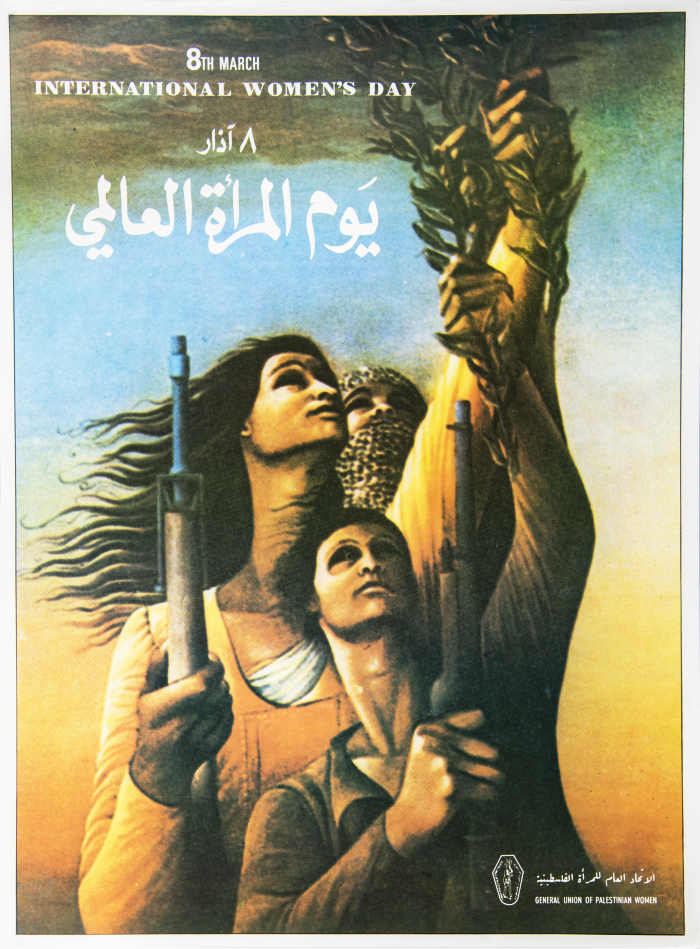
"International Women's Day", a GUPW Poster, 1980


This poster was issued by the General Union of Palestinian Women (GUPW) on International Women's Day in 1989, which includes a painting by Palestinian artist Sliman Mansour.

digital exhibition page


A People by the Sea:Narratives of the Palestinian Coast


A People by the Sea: Narratives of the Palestinian Coast sheds light on the history of the Palestinian coast. It considers possible futures by reviewing and reflecting on past experiences. Starting from the mid-18th century and ending in 1948, the exhibition allows for a re-examination of the Nakba through a presentation of two hundred years of historical landmarks.
 
The exhibition includes focused narratives: The first one highlights the rise of Akka (Acre) in the mid-18th century, highlighting its political, economic, urban, and architectural history before modern states’ formation in the region. A second narrative focuses on the rise of Yafa (Jaffa) in the 19th century, with the gradual concentration of capital and trade in Palestine’s coastal cities. This was accompanied by a growing European influence in the mid-19th century, which led to the 20th century Nakba and the fall of the country.


The history of the Palestinian people is one of a complex society with historical continuity on their land. The people of Palestine succeeded in forging diverse manifestations of their deep-rooted existence in the land, through a continuous history and in a semi-independent manner, outside the bounds of official state constructs and encroachments of invading powers that successively ruled the region for centuries - the last of which being the current colonial rule. The presence of an enduring and vibrant Palestine is evident through its urban, architectural, economic, social, and political ensembles and structuring, prior to modern nation-states’ formations and their ensuing demarcation of political borders. That presence is continuously established and reinforced through Palestinians’ steadfastness and will for self-determination, and their close bond with their land and sea.

Posters

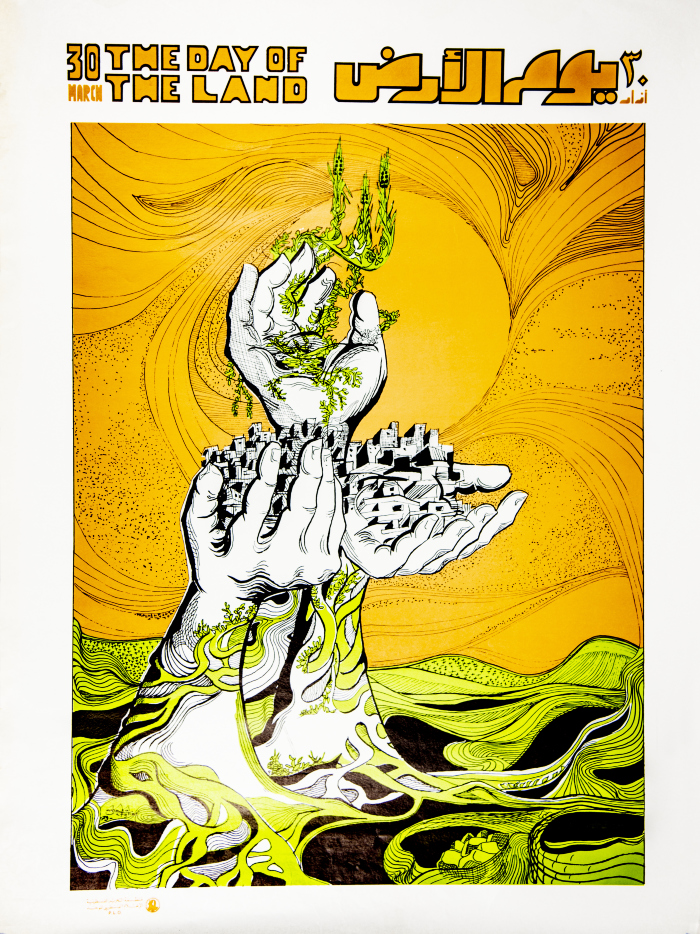
"Land Day", a PLO Poster, 1985


This poster was issued by the Unified Information of the Palestine Liberation Organization (PLO) on Land Day in 1985.

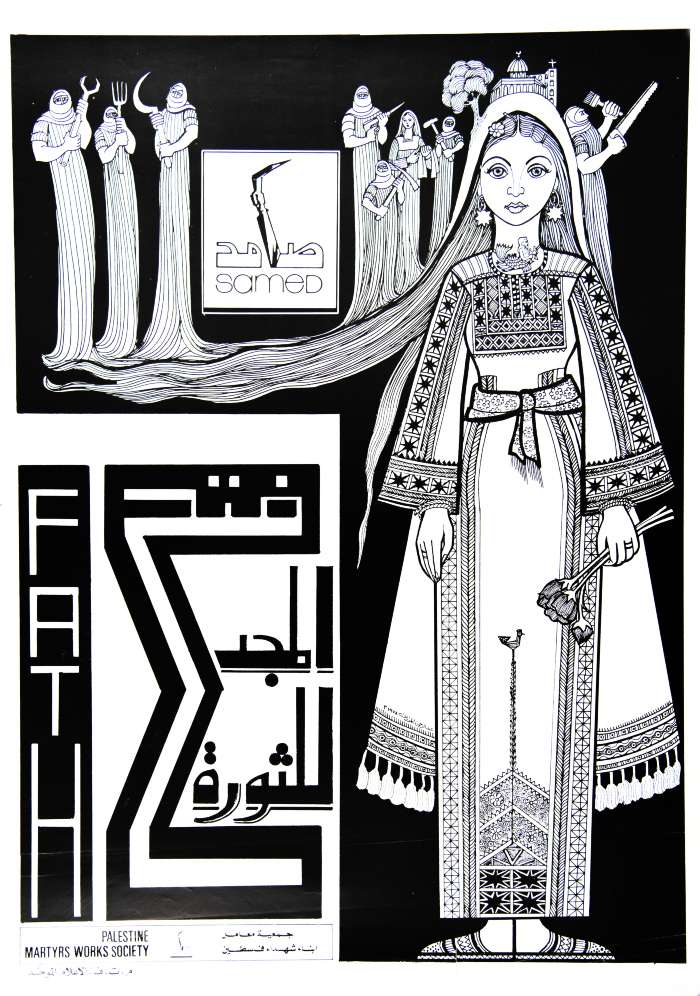
"Glory to the Revolution", a PLO Poster, 1979


Issued by the Unified Information of the Palestine Liberation Organization (PLO) in 1979, this poster shows a painting by Abder-Rahman al-Muzayyan.

"International Women's Day", a GUPW Poster, 1980


This poster was issued by the General Union of Palestinian Women (GUPW) on International Women's Day in 1989, which includes a painting by Palestinian artist Sliman Mansour.

Ready-to-display mobile exhibitions


Introduction

We present to you our digital package! The packages contain a collection of printable and usable materials for display, including but not limited to pictures of artworks, infographics and statistics, posters, photographs, videos, audio recordings, and other various sources, all of which will transport our exhibition to your communities and spaces.

The ready-to-download, print and display DIY exhibitions of the Palestinian Museum have been designed to be easy to install and adaptable to various locations and display spaces, such as libraries, community centres, institutions, shopping centres, schools, universities, museums, galleries, and more.

Purpose of the ready-to-download, print and display exhibitions

The ready-to-download, print and display exhibitions aim to provide information and the necessary tools to engage global communities and help the public understand Palestinian society and its issues, including the struggle for freedom and self-determination. By making this information accessible, we hope to bring more audiences around the world closer to the reality of the historical, political, and economic contexts that contributed to shaping general cultural and creative production in Palestine.

Available tool library

These ready-to-download, print and display exhibitions offer a variety of materials and tools in both Arabic and English, ranging from artworks, archival materials, posters, photographs, infographics and statistics, media materials, videos, and audio recordings, all of which are available in digital versions adaptable to multipurpose spaces.

How can you host the museum’s ready-to-download, print and display exhibitions?

To access the available tools library within the ready-to-download, print and display exhibitions, you must fill out a request through our website. Upon the reception and approval of your request, you will receive an email that includes instructions to access the library. If you have questions about the application or the available exhibitions, please contact us via email: info@palmuseum.org 


FAQ

What is a ready-to-download, print and display exhibition?

It is a package of free materials prepared for print-on-demand, tailored to the host's needs and the space they choose for display. It includes a variety of materials and tools on a specific topic or issue, which together form a comprehensive and specialised exhibition.


Are there specific requirements for hosting ready-to-download, print and display exhibition?

When hosting a ready-to-download, print and display exhibition, it is required to fully comply with using the pre-prepared materials by the Palestinian Museum. No changes to the content or design are allowed, and the Palestinian Museum's copyrights must be acknowledged when using one of its exhibitions. We must emphasise that these exhibitions only be used for non-profit educational purposes.


What is the cost of displaying a ready-to-download, print and display exhibition?

The ready-to-download, print and display exhibitions are available for free, and the Museum does not charge any fees for their use. The host is responsible for the cost of printing and all expenses related to exhibition set-up, which vary depending on the nature of the location, the materials used for printing, the size of the prints, and the exhibition space.


Is it required to display the entire ready-to-download, print and display exhibition?

The hosting entity can choose the number and size of panels and materials to be displayed, depending on the nature of the location, its space, and the target audience. However, it is required to use the exhibition's title panel and the main panels and materials within the available materials library to make the exhibition understandable and comprehensive. Digital display screens can be used within the exhibition space, but electronic or virtual displays are prohibited.


Is it possible to make modifications to the ready-to-download, print and display exhibition?

The available tool library within the Museum's ready-to-download, print and display exhibitions includes modifiable templates, allowing hosts to tell stories that align with their communities' interests and expectations, taking into consideration the nature of the display location and its spaces. Therefore, no modifications are allowed to the content of the pre-prepared materials or their designs.


How do I prepare an exhibition from among the ready-to-download, print and display​​​​​​​ exhibitions?

You should start by filling out a request to gain approval to access the available materials library within the exhibition. Once you have obtained approval, you can download the files you have chosen to print. It is recommended to start with the resource guide and instructions for more details on printing and installation.